
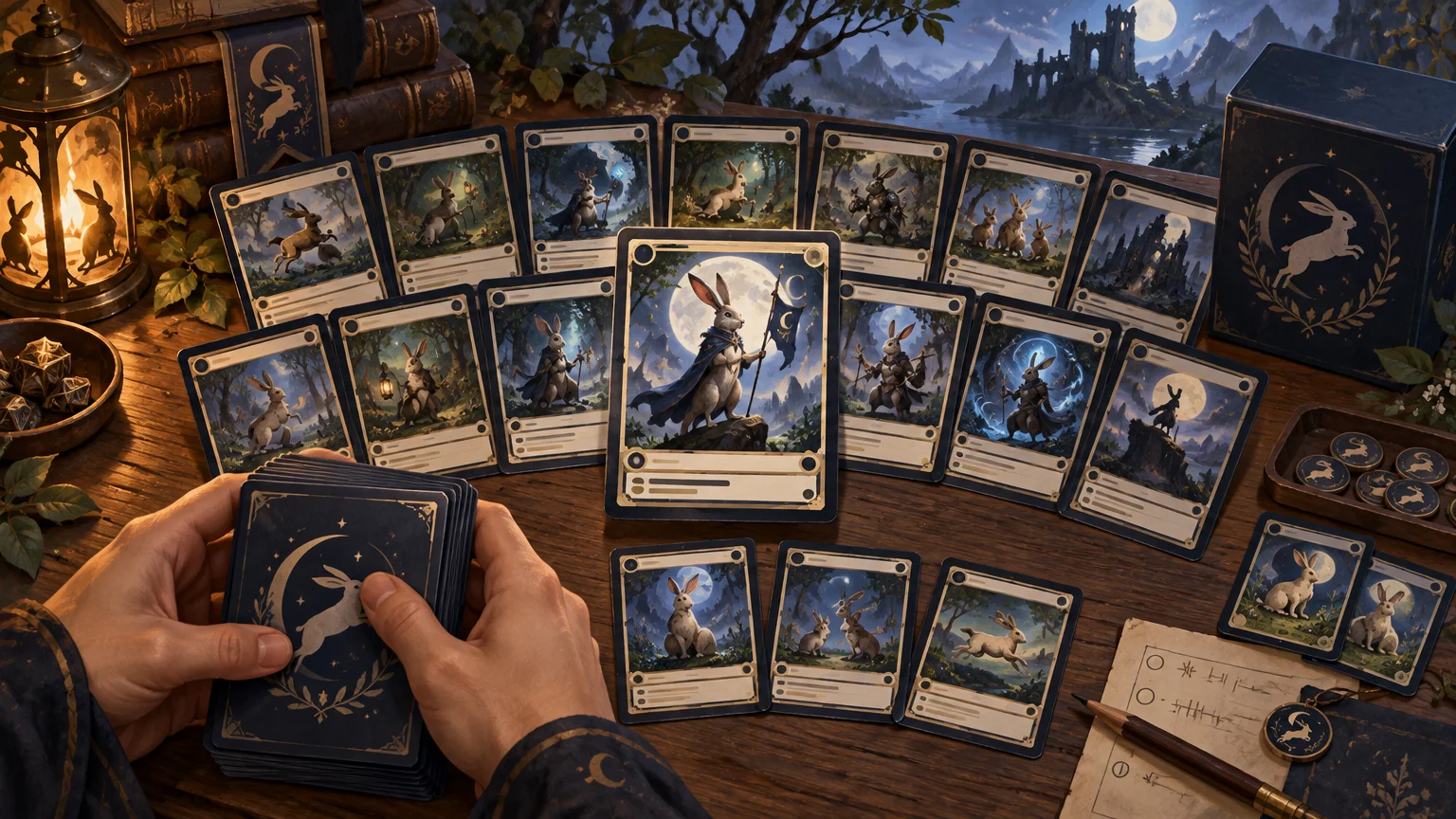
TLDR: The best Hare Apparent proxy option depends on whether you are still testing the copy count or have locked the deck. Start with inexpensive playtest copies while tuning. Once the number is stable, either order one matching Hare Apparent package or print the entire 100-card deck together for maximum consistency. Keep Rabbit tokens separate, preserve enough non-Hare slots for mana and interaction, and audit every quantity before ordering.
A Hare Apparent proxy project is less like adding one expensive staple and more like managing inventory for a very small rabbit warehouse. The card explicitly permits any number of copies in a deck, so the normal Commander singleton restriction does not force you to stop at one. The real question is how many copies make your chosen deck function without crowding out lands, draw, protection, and recovery.
The practical answer is to treat the repeated cards, the rest of the 99, and the token package as three separate components. Decide the Hare count first, test that count, and then create one exact source list for the finished order. That prevents the two most common quantity-deck failures: ordering the wrong number of repeated cards and discovering that the supposedly complete list contains 101 cards.
Why a Hare Apparent proxy deck needs a different workflow
Hare Apparent is a white 1W 2/2 Rabbit Noble. Its enters-the-battlefield ability creates 1/1 white Rabbit creature tokens based on the number of other Hare Apparents you control, and its card text permits any number of copies in a deck. That final line overrides the ordinary same-name restriction because Magic’s rules give directly conflicting card text precedence over a general rule. The official Magic Comprehensive Rules explain both Commander construction and that card-text principle.
This exception changes the physical deck project. A conventional singleton list usually needs one image and one quantity entry for almost every nonbasic card. A Hare deck may need dozens of copies of one card, followed by a much smaller package of unique support cards. A single quantity typo can therefore change the entire composition of the deck.
It also makes testing before a polished order particularly valuable. Adding more Hares increases access to the deck’s namesake creature, but each added copy consumes a slot that could have been a land, draw spell, protection piece, removal spell, or payoff. More rabbits is a theme. It is not automatically a complete deckbuilding plan.
Confirm the Commander rules before choosing a quantity
A Commander deck contains exactly 100 cards including its commander. In the standard structure, that means one commander and 99 cards in the deck. Cards in those 99 must fit the commander’s color identity, so a deck containing white Hare Apparents needs a commander whose color identity includes white. The official Commander format overview provides the basic 99-plus-commander structure and color-identity framework.
Hare Apparent’s any-number text removes the same-name obstacle, but it does not remove the 100-card limit or color-identity requirement. The simplest quantity equation is:
Non-Hare cards in the 99 = 99 minus the number of Hare Apparents.
If you test 20 Hares, you have 79 other library slots. At 30 Hares, you have 69. At 40, only 59 slots remain for the mana base and every support package. These are useful test points, not claims that any one count is universally correct.
| Prototype | Hare Apparents | Other cards in the 99 | What the test reveals |
|---|---|---|---|
| Support-heavy | 20 | 79 | Whether tutors, recursion, draw, or other creatures provide enough access to the core plan |
| Balanced starting test | 30 | 69 | Whether the deck can repeatedly deploy Hares while retaining functional support packages |
| Hare-dense | 40 | 59 | Whether greater creature density is worth the pressure placed on lands and support slots |
Build and goldfish more than one version before committing to a large matching batch. If the 40-copy version repeatedly lacks mana or meaningful follow-up plays, the problem is not solved by a forty-first rabbit. If the 20-copy version rarely presents the namesake plan, move upward or improve how the deck finds and reuses its creatures.
Choose the right proxy option for your stage
Use temporary playtest copies while the count is changing
Basic paper playtest cards are the efficient choice when you are deciding whether the deck wants 20, 30, or 40 copies. Clearly label every copy with the card name, mana cost, and essential rules text. The purpose is not presentation; it is learning how the copy count affects opening hands, curve, recovery, and the space available for support.
Change the count in meaningful batches rather than replacing one card after every game. Record what you cut and why. Otherwise, you can easily confuse a quantity problem with a mana-base change or a newly added payoff.
Order a matching Hare-only package when the shell already exists
A repeated-card package makes sense if you already own or have proxied the commander, lands, interaction, and payoffs. Lock the exact Hare quantity and order a few replacement copies only if you genuinely expect artwork changes, damage, or future experimentation. Ordering a vague pile “just in case” usually leaves you with extras while another necessary card remains missing.
If you want a print-on-demand route for a locked repeated-card batch, printing the Hare Apparent package through PrintMTG is one available approach. Keep the order file separate from your token list so Rabbit tokens do not accidentally replace cards in the 99.
Print the complete deck together when the list is settled
A complete 100-card build is the cleanest option when you want consistent sizing, framing, typography, and visual direction across the deck. It also makes sense when most of the support shell is being proxied anyway. Follow a finished Commander proxy deck workflow rather than treating the Hare stack as an isolated purchase.
The tradeoff is reduced flexibility. If testing later shows that 35 copies should have been 27, you will have more unused cards and will need new support pieces. Full-deck production should therefore come after the quantity experiment, not before it.
Protect the slots the rest of the deck needs
After choosing a provisional Hare count, reserve the remaining slots by function. Do not begin with dozens of individual favorites and hope they somehow form a deck around the rabbits.
- Mana: lands and other mana sources appropriate to the commander, colors, and curve.
- Card flow: draw, selection, or other ways to avoid emptying your hand without a follow-up.
- Interaction: answers suited to the speed and threats expected in your group.
- Protection: cards that preserve an important board or help the deck rebuild after disruption.
- Payoffs: effects that reward creature entries, tokens, attacking, or the specific plan selected for the deck.
- Recovery: recursion or replacement resources for games where the first Rabbit wave disappears.
- Utility: cards required by the commander or local power expectations rather than by the Hare theme itself.
These are functional categories, not mandatory fixed ratios. A low-curve commander with built-in card advantage can allocate slots differently from a commander that is expensive and provides no cards. Likewise, a casual theme build may prefer flavorful Rabbit payoffs, while a higher-power version needs cheaper interaction and a more deliberate recovery plan.
Use the intended game experience as the deciding factor. If the deck is meant for upgraded casual tables, discuss its speed, resilience, and strongest payoffs rather than merely saying it contains proxies. The Commander Brackets proxy-deck guide offers a broader framework for matching a finished list to a playgroup.
Plan Rabbit tokens outside the 100 cards
Tokens are game objects rather than cards in the Commander deck, so they do not consume slots in the 100-card list. Maintain a separate helper-piece list containing Rabbit tokens, counters, reminder cards, and any other markers the deck actually uses.
There is no universal number of physical Rabbit tokens to order. You can represent several equivalent tokens with one token card and a die, use multiple token cards to show tapped and untapped groups, or carry a larger visual swarm. Choose based on how complicated the board becomes and how clearly opponents can read it.
At minimum, your token setup should make power and toughness, tapped status, summoning status when relevant, and the number of represented creatures understandable. One gorgeous token under a die showing 38 can be compact, but separate token groups may be clearer when some are tapped, attacking, modified, or affected by different effects.
Keep repeated copies cohesive and readable
Matching art gives the deck an immediate visual identity and makes the Hare Apparents easy to recognize across the table. Different illustrations can also work, but every version should clearly display the same card name and remain distinguishable from Rabbit tokens and other creatures.
For the most usable repeated package, keep the following elements consistent:
- The exact card name, prominently placed on every copy.
- Mana cost, type line, power and toughness, and functional rules information.
- A frame or layout that does not make one copy look like a different game object.
- Sufficient contrast for normal table lighting.
- A visibly different token treatment so library cards and helper pieces cannot be confused.
- Consistent card orientation, backs, and sleeving throughout the finished deck.
A mixed-art swarm is easiest to manage when the frame and text placement stay consistent. If every Hare uses a different illustration, frame, nickname, and text layout, the deck may look like an art gallery that has developed a rabbit problem. Cohesion should support recognition, not compete with it. For more visual planning ideas, see these cohesive Commander deck themes.
Build one quantity-checked source of truth
Before ordering, create a final list containing exactly one commander and 99 library cards. Remove maybeboard entries, considering cards, category headings, and duplicate export lines. Then keep tokens in a second list.
- Lock the commander and confirm that its color identity includes white.
- Set the final Hare Apparent quantity.
- Confirm that the remaining non-Hare cards bring the library to exactly 99.
- Check every repeated support card and basic-land quantity.
- Remove maybeboard and sideboard entries from the production file.
- Create a separate token and helper-piece inventory.
- Match every line in the order interface against the locked list.
- Save a dated copy of the final list so later edits do not create version confusion.
A deck-hosting export can help, but do not assume the export contains only the cards you intend to print. The maybeboard is patient. It will wait until checkout to become a financial participant. The Moxfield-to-proxy ordering guide covers the list-cleanup process in more detail.
Discuss proxies and power before game night
Commander is presented as a social format, so pregame communication is part of establishing the expected experience. Tell the group that the deck uses proxies, explain the general plan, and describe the intended power level. A stack of repeated Hares may be charming, highly tuned, fragile, resilient, or some combination of those depending on the commander and support shell.
Proxy acceptance varies among playgroups, stores, organizers, and events. Ask rather than assuming. If you are attending an organized event, check its current rules directly with the organizer; casual approval from one pod does not establish a universal event policy.
Check the finished deck before sleeving up
When the cards arrive, sort the Hare Apparents into counted piles, then verify the complete deck independently. Check names, quantities, readability, cuts, corners, and whether the cards sit consistently in the chosen sleeves. Commander Proxies’ proxy quality checklist provides a more complete arrival inspection workflow.
- One commander is present.
- The library contains exactly 99 cards.
- The Hare Apparent count matches the locked list.
- No Rabbit token has entered the library pile.
- All required tokens and counters are present separately.
- Repeated copies are readable and visually identifiable.
- Cards cannot be distinguished from one another by touch or unusual shine through normal sleeves.
- The saved digital list matches the physical deck.
Final recommendation
Do not begin by ordering the largest Hare Apparent stack your enthusiasm can justify. Build three provisional lists with different copy counts, test which one leaves enough room for the deck’s mana and support plan, and lock that number before choosing polished art.
Use temporary copies while the quantity is moving, a matching Hare-only package when you already have the shell, or a complete 100-card order when the whole list is settled. Keep tokens separate, maintain one dated source list, and count the physical deck before game night. That process produces something better than a pile of rabbits: a Rabbit deck that is actually ready to play.
References
- Hare Apparent | Foundations | Standard | Card Kingdom
- media.wizards.com
- MTG Commander Format | Magic: The Gathering
- MTG Commander Proxy Decks: How to Turn a 100-Card List Into a Finished Deck – MTG Commander Proxies
- MTG Proxy Quality Checklist: What to Look For When Your Deck Arrives – MTG Commander Proxies