
TLDR
A Commander Brackets proxy deck should be built around the kind of game you want, not just the strongest cards you can print.
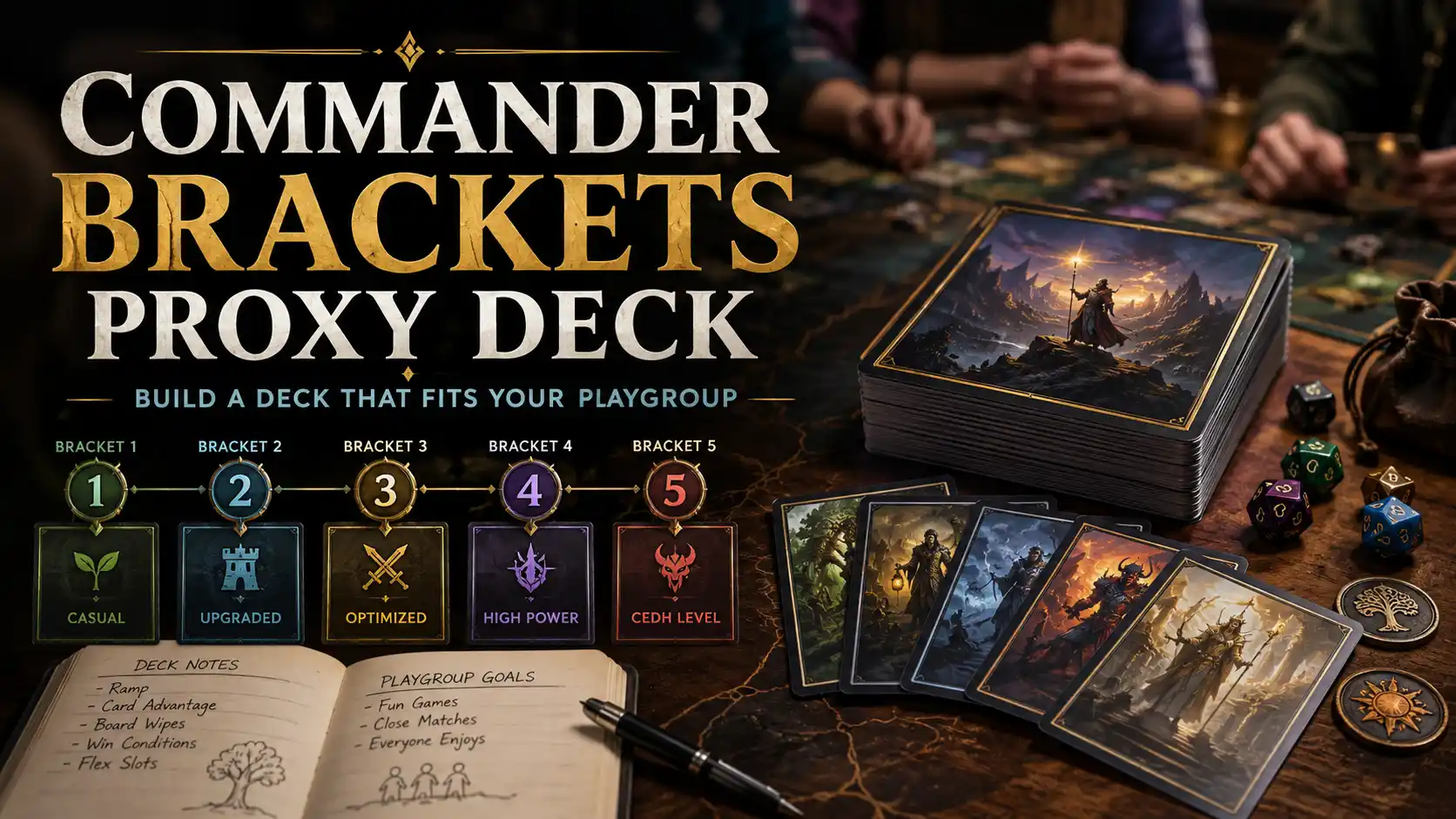
Use Commander Brackets as pregame language: Bracket 1 for theme-first decks, Bracket 2 for low-pressure casual games, Bracket 3 for upgraded casual, Bracket 4 for optimized power, and Bracket 5 for cEDH.
Before you proxy the deck, check your Game Changers, win speed, combo density, tutors, fast mana, and playgroup expectations.
The best proxy deck is not always the most powerful one. It is the one your table actually wants to play against again.
Why Commander Brackets Matter More When You’re Using Proxies
Proxying removes one of the biggest limits in Commander: price. That is great. It lets players test ideas, build decks they could never justify buying card-for-card, and actually play the format instead of staring at a shopping cart full of bad news.
But it also creates a small problem.
A Commander Brackets proxy deck can jump from “fun upgraded casual deck” to “why are we dead on turn four?” very quickly. When money stops being the limiting factor, deck intent becomes more important. You are no longer asking, “Can I afford Mana Vault, Demonic Tutor, Gaea’s Cradle, and The One Ring?” You are asking, “Should this deck have those cards for the kind of game I want?”
That is where Commander Brackets help. They give players a shared way to talk about power level before the game starts. They are not perfect. No system is. But they are much better than saying “my deck is a seven” and hoping everyone somehow means the same thing.
If you are building a full deck through CommanderProxies.com, the bracket conversation is worth having before the deck is finalized. It helps you choose the right staples, cut the wrong ones, and avoid the classic Commander problem: four players sitting down for four different games.
What Is a Commander Brackets Proxy Deck?
A Commander Brackets proxy deck is a proxied Commander deck built with a clear power bracket in mind.
That means the deck is not just legal. It is also honest about its intended play experience.
A Bracket 2 proxy deck might have a strong theme, a few efficient cards, and slower win conditions that the table can see coming. A Bracket 3 proxy deck might use stronger interaction, cleaner mana, better card draw, and a few Game Changers. A Bracket 4 proxy deck may be fast, consistent, and openly built to end games quickly.
Same format. Very different expectations.
That distinction matters because Commander is social. The rules tell you what you are allowed to play. The table tells you what people actually want to play against.
Start With Deck Intent, Not Card Price
This is the biggest mindset shift.
A lot of players proxy because expensive cards become accessible. That makes sense. If a card costs more than the rest of the deck combined, a proxy is a practical way to test it or use it in casual play.
But a proxy deck should not automatically become a pile of the most efficient cards in your colors.
Before you pick the staples, answer three questions:
- What turn should this deck usually become dangerous?
- How does this deck win?
- Would I be happy if another player brought this same experience to the table?
That last question does a lot of work. It is easy to justify your own sharp edges. It is harder to sit across from them.
For example, a Bracket 3 Muldrotha deck can be strong without being miserable. It might recur value permanents, grind through removal, and eventually win with a big engine. But if the same deck adds fast mana, efficient tutors, compact combos, and lock pieces, the “graveyard value” label stops telling the full story.
The deck did not become stronger by accident. It changed intent.
Match the Bracket to the Game You Want
The bracket system works best when you use it as plain language. Do not treat it like a loophole puzzle. Treat it like a promise.
Bracket 1: Exhibition
Bracket 1 is for theme-first decks. These are the decks that care more about showing off an idea than winning efficiently.
This is a great space for custom art proxies, unusual commanders, silver-bordered-style conversations, or highly specific themes. Maybe every card has a dragon in the art. Maybe the deck is built around a movie-inspired concept. Maybe the win condition is charming and inefficient.
A Bracket 1 Commander Brackets proxy deck should be clear about what it is doing. The proxy part can actually help here because the deck can look cohesive and intentional even when the card choices are more expressive than optimized.
Good proxy use here:
- Custom art treatments for a theme deck
- Matching lands and tokens
- Lower-power cards that fit the story
- Cards chosen because they are fun, not because they are optimal
Avoid turning Bracket 1 into “secretly powerful but with cute art.” The table will notice.
Bracket 2: Core
Bracket 2 is the casual baseline for a lot of playgroups. Decks are functional, but not tuned to punish every stumble.
This is where many upgraded precon-style builds live. You might improve the mana base, add better removal, and smooth out the strategy. But the deck should still let the table breathe. Win conditions should usually be visible, disruptable, and not too fast.
Good proxy use here:
- Replacing overpriced casual staples
- Testing a cleaner mana base
- Making a budget deck feel complete
- Printing missing tokens or helper cards
Be careful with cards that technically fit but change the feel of the game. A casual deck with a single Rhystic Study may still be fine in some groups, but it also changes the conversation. Say it up front.
Bracket 3: Upgraded
Bracket 3 is where many proxy decks naturally land.
This is the “my deck is strong, but I’m not trying to cEDH people” range. The deck has better card quality, stronger synergy, more interaction, and maybe a few Game Changers. It can make big plays. It can recover after removal. It can win out of nowhere sometimes, but it should not regularly end the game before people have played real Magic.
A Bracket 3 Commander Brackets proxy deck is a good home for cards like upgraded mana, strong draw engines, efficient removal, and a limited number of high-impact staples.
Good proxy use here:
- Testing expensive staples before buying
- Building a polished version of a favorite commander
- Adding a few Game Changers with clear disclosure
- Making the deck consistent without making it oppressive
The main mistake is pretending Bracket 3 means “anything short of cEDH.” It does not. Bracket 3 still has social expectations.
Bracket 4: Optimized
Bracket 4 decks are powerful on purpose.
These decks are faster, more consistent, and less forgiving. They may use fast mana, efficient tutors, free interaction, compact win conditions, and stronger engines. This is not necessarily cEDH, but it is clearly high power.
A Bracket 4 proxy deck should be announced as such. No coy phrasing. No “it’s just my casual deck” while you keep a hand with fast mana, tutor, protection, and a deterministic win line.
Good proxy use here:
- Building high-power decks without buying every expensive staple
- Testing tournament-adjacent shells
- Trying strong cards in real games before committing
- Making an optimized list visually consistent
The tradeoff is simple: Bracket 4 games can be exciting, but they need consent. Some players love that speed. Some do not. Both are fine.
Bracket 5: cEDH
Bracket 5 is competitive Commander.
The goal is to win. The deck is built with efficiency, consistency, and the metagame in mind. The social contract is different because everyone sits down expecting sharp play and powerful cards.
Proxying is common in many cEDH communities because it helps players test and compete without card availability deciding who gets to play the format. Still, each event, store, or group may have its own rules. Ask first.
Good proxy use here:
- Testing cEDH lists
- Playing expensive staples in casual cEDH pods
- Keeping multiple competitive decks available
- Avoiding unnecessary wear on real cards
For sanctioned events, do not assume proxies are allowed. Official tournament policy is a separate issue from casual Commander norms.
Use Game Changers as Disclosure Cards
Game Changers are not just “good cards.” They are cards that can strongly affect how a Commander game feels.
That includes things like fast mana, efficient tutors, snowballing engines, resource denial pieces, and cards that can create the kind of game some players would rather avoid. The important part is not memorizing every argument about every card. The important part is disclosure.
Before a game, say the relevant part plainly:
“My deck is Bracket 3. It has Rhystic Study, Demonic Tutor, and The One Ring, but no fast combo.”
That sentence is useful. It gives the table something real to work with.
Compare that to:
“It’s upgraded casual.”
That could mean almost anything.
If you are ordering or building a Commander Brackets proxy deck, review the Game Changers before you finalize the list. You do not have to avoid them entirely unless your target bracket calls for that. But you should know which ones are in the deck and why they belong.
A Simple Proxy Deck Bracket Checklist
Before you print or order the deck, run through this checklist.
What bracket am I aiming for?
How quickly can this deck usually win?
Does the deck include any Game Changers?
Does the deck have two-card infinite combos?
Does the deck use fast mana?
Does the deck use efficient tutors?
Does the deck prevent opponents from playing normally?
Does the deck rely on mass land denial?
Would I describe this deck the same way if I were playing against it?
That last one is the honesty check. A lot of pregame problems come from describing the deck by its theme while hiding how it actually wins.
“Pirate deck” sounds casual.
“Pirate deck with fast mana, Dockside loops, free counters, and a compact combo finish” is a different sentence.
Use the second kind of sentence.
How Proxies Can Make Bracket Conversations Easier
A good proxy deck is not just about price. It can make the deck easier to understand.
Matching tokens, readable text, consistent frames, and clear card names all help the table follow the game. That matters more as the deck gets stronger. If your deck uses custom art for everything, the cards still need to be readable across the table.
This is one reason full-deck presentation matters. CommanderProxies focuses on cohesive decks, clean formatting, and table-ready readability. The goal is not just “cool art.” The goal is a deck that looks finished and still plays smoothly.
That matters for bracket clarity too. A Bracket 3 or Bracket 4 deck with custom art should still make important cards easy to recognize. Your opponents should not have to decode the board every turn.
For more on the production side, the How We Print page explains the focus on crisp text, consistent color, UV coating, and die cutting.
What to Say Before the Game
The pregame conversation does not need to become a courtroom hearing.
Here is a clean script:
“This is a Bracket 3 upgraded deck. It has three Game Changers, no fast mana outside Sol Ring, and one infinite combo that usually needs several pieces. It can win around turn six or seven if nobody interacts.”
That is enough for most tables.
For a stronger deck:
“This is Bracket 4. It has fast mana, efficient tutors, free interaction, and a compact combo finish. It is not cEDH, but it is built to be fast.”
For a theme deck:
“This is Bracket 1. It is a full vampire movie theme deck with custom art. It bends normal card choices for flavor, and it is not trying to be optimized.”
These short descriptions help people choose the right deck in response. That is the whole point.
Common Mistakes When Building a Commander Brackets Proxy Deck
The first mistake is using proxies to erase every weakness. Commander decks are more fun when they still have texture. If every card is the best possible version of its effect, you may end up with a deck that is technically impressive and not very fun for your pod.
The second mistake is ignoring win speed. A deck can have zero Game Changers and still be too fast for the table. Brackets are about game experience, not just card names.
The third mistake is hiding behind theme. A deck can have a silly creature type and still be brutal. Squirrels can hurt people. So can Clowns. Magic is like that.
The fourth mistake is not checking the current rules and bracket updates. Commander has seen real changes in recent years, and the bracket system is still a developing tool. If your article, deck page, or playgroup doc is old, review it before relying on it.
The fifth mistake is assuming every store or event treats proxies the same way. Casual kitchen table games, unsanctioned store nights, webcam pods, and official events can all have different expectations. Ask before you shuffle up.
Final Thoughts
A Commander Brackets proxy deck works best when it is honest.
That sounds simple, but it solves most of the problem. Pick the game experience first. Choose the bracket second. Then build the deck to match that promise. If you want a strong deck, build a strong deck and say so. If you want a goofy theme deck with custom art and slow wins, protect that experience by not stuffing it full of cards that pull it into another bracket.
Proxies make Commander more accessible. Commander Brackets make the conversation clearer. Put those together and you get something better than a cheaper deck. You get a deck that fits the table.
And that is the part people remember after the game ends.
FAQs
Are Commander proxy decks allowed in official tournaments?
Player-made proxies are not generally allowed in sanctioned Magic events. They are mainly for casual play, testing, and unsanctioned games where the group or organizer allows them. Always check the event rules before bringing proxies.
Can I use Game Changers in a casual proxy deck?
Yes, depending on the bracket and your table. The important part is disclosure. Tell the pod which Game Changers are in your deck before the game starts so everyone can choose an appropriate deck.
What bracket should my first Commander proxy deck be?
Bracket 2 or Bracket 3 is usually the safest starting point for most casual groups. Bracket 2 works well for relaxed games. Bracket 3 works well if your group already plays upgraded decks with strong synergy and better interaction.
Is a proxy deck automatically higher power?
No. A proxy deck can be low-power, casual, theme-first, optimized, or cEDH. Power comes from card choices, speed, consistency, tutors, fast mana, combos, and interaction. The fact that the cards are proxies does not decide the bracket by itself.
Should custom art proxies still use readable card text?
Yes. Readability matters. Custom art is great, but opponents still need to identify cards, understand board states, and follow the game. Clean names, clear type lines, and readable rules text make custom proxy decks much easier to play against.