
TLDR
Demon decks in MTG are usually black, Rakdos, or Grixis decks built around big creatures, life payment, sacrifice, card draw, and removal.
The best Demon decks usually need three things: ramp, ways to survive the early turns, and enough payoff cards to make the expensive threats worth casting.
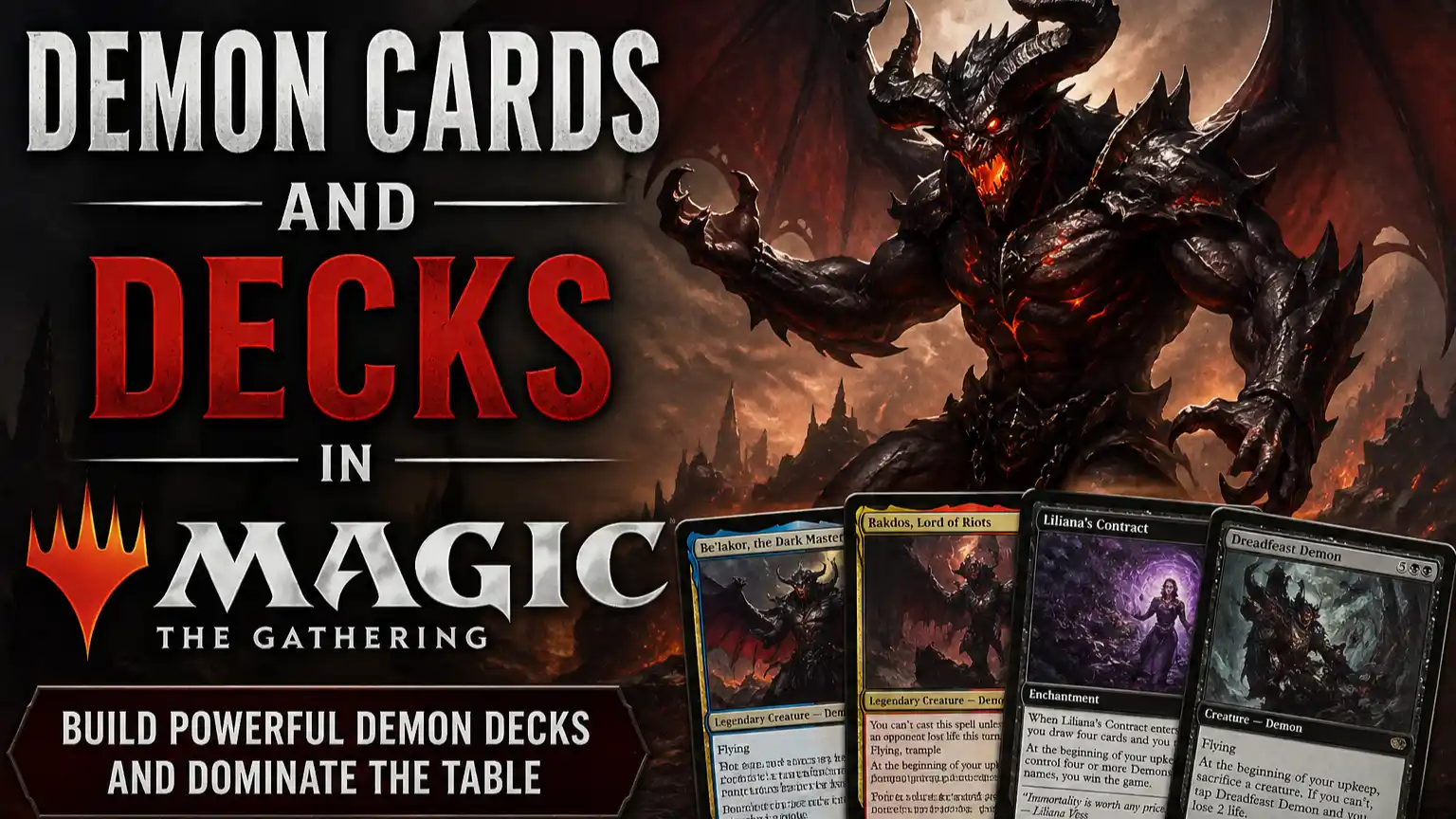
For Commander, Be’lakor, the Dark Master is the cleanest Demon tribal leader. Rakdos, Lord of Riots is faster and more explosive. Liliana’s Contract gives the deck a funny but real alternate win condition.
The Appeal Of Demon Cards In Magic: The Gathering
Demon cards in Magic: The Gathering have a very clear promise: you get power, but the bill comes due.
That bill might be life loss. It might be sacrificing creatures. It might be discarding cards, paying mana up front, or accepting that your six-drop does nothing if it gets removed before combat. That’s the fun of it. Demons are not clean little value creatures. They are oversized problems with wings.
A good Demon deck leans into that. It doesn’t try to play fair in the normal way. It ramps, kills early creatures, draws extra cards, and then drops threats that make the table stop talking for a second. That’s the correct Demon experience.
And since many of the coolest Demon lists are expensive to assemble in paper, this is also a good deck type to test before committing. For casual deck testing, full Commander builds, or custom playtest copies, PrintMTG’s MTG proxy printing guide is the most natural fit here because Demon decks often want a lot of splashy rares and mythics before you know which version you actually like.
What Makes A Card Feel Like A Demon?
Most Demon cards share a few design patterns:
Big bodies.
High mana costs.
Flying.
Life payment.
Card draw.
Sacrifice costs.
Discard pressure.
Removal or damage attached to creatures.
That gives Demon decks a very different feel from Elves, Goblins, or Zombies. You usually aren’t flooding the board with cheap tribal pieces. You’re trying to survive long enough to land one or two cards that change the whole game.
That means the best Demon cards are not always the biggest ones. A seven-mana Demon with no immediate impact can be worse than a five-mana Demon that draws cards, forces sacrifice, tutors, or stabilizes your life total. The question is not just “how scary is this creature?” It’s “what happens if I cast this and pass the turn?”
That little question saves a lot of bad deck slots.
The Best Commanders For Demon Decks
Be’lakor, The Dark Master
Be’lakor is the cleanest Demon tribal commander because he rewards you for doing the thing you already wanted to do: putting Demons onto the battlefield. He draws cards when he enters based on the number of Demons you control, and his damage trigger turns future Demons into removal or reach.
He also gives you Grixis colors: blue, black, and red. That matters. Black gives you Demons, tutors, removal, and reanimation. Red gives you damage, haste, impulse draw, and Rakdos-style pressure. Blue gives you card selection, clones, protection, and a few cleaner ways to keep the engine moving.
Be’lakor is not subtle. But he is coherent.
Rakdos, Lord Of Riots
Rakdos, Lord of Riots is less “Demon tribal lord” and more “cost-reduction engine that happens to be a Demon.” You need an opponent to lose life before you can cast him, but once Rakdos is online, your big creature spells can become absurdly cheap.
This version wants cheap ways to deal early damage: pingers, burn spells, evasive creatures, or effects that make each opponent lose life. Then Rakdos turns your hand full of expensive monsters into a discount bin from hell.
The tradeoff is consistency. Rakdos can have explosive turns, but the deck needs setup. No damage, no commander. No commander, no discount. When it works, it feels incredible. When it stumbles, you may stare at a hand full of six-drops and reconsider your choices.
Raphael, Fiendish Savior
Raphael is not technically a Demon, but he supports Demons, Devils, Imps, and Tieflings. That makes him useful for a lower-to-the-ground Rakdos build that still wants the Demon flavor without depending only on huge creatures.
The lifelink bonus is a bigger deal than it looks. Demon decks pay life all the time, so lifelink helps offset your own card draw and pain effects. Raphael also rewards creatures dying, which fits sacrifice themes and disposable Devil tokens.
This is the commander to look at when pure Demon tribal feels too clunky.
Other Demon Commanders Worth Considering
There are plenty of legendary Demons, but not all of them are good tribal commanders. Some are better as top-end threats inside other decks.
Good names to consider include:
- Vilis, Broker of Blood for life-payment card draw.
- Razaketh, the Foulblooded for sacrifice and tutoring.
- Demonlord Belzenlok for mono-black value.
- Varragoth, Bloodsky Sire for cheaper utility.
- Rakdos, the Showstopper for chaotic Demon-heavy builds.
- Valgavoth, Terror Eater for a newer, nastier top-end threat.
The big lesson: don’t pick a Demon commander only because it is a Demon. Pick the commander that gives your deck a plan.
The Main Demon Deck Strategies
Demon Tribal Commander
This is the most obvious version. You play a pile of powerful Demons, support them with mana rocks and removal, and use cards like Be’lakor or Liliana’s Contract to reward the creature type.
The risk is curve. Demon tribal decks can become six-drop soup very quickly. That looks cool in a deck editor and plays badly at a real table.
A healthier Demon tribal deck has:
- Early ramp.
- Cheap removal.
- A few sacrifice outlets.
- Card draw that starts before turn six.
- Reanimation to recover from removal.
- Demons with enter-the-battlefield effects.
That last point matters. A Demon that does something right away is much better than a Demon that needs to survive a full turn cycle.
Rakdos Demons
Rakdos Demons cut blue and focus on black-red pressure. These decks tend to be faster, meaner, and a little less stable than Grixis lists.
You get access to damage-based enablers, group slug effects, haste, sacrifice payoffs, and efficient black interaction. Rakdos is also the best color pair for making the table bleed while your bigger threats come online.
This is a good home for cards that make each opponent lose life, because those effects enable Rakdos, Lord of Riots and help close games once your Demons are attacking.
Reanimator Demons
Reanimator may be the most practical Demon shell. Instead of paying seven or eight mana fairly, you discard or mill huge Demons and bring them back early.
This plan makes expensive cards much easier to justify. It also lets you play a higher top-end without completely ruining your curve.
A reanimator Demon deck wants:
- Discard outlets.
- Entomb-style graveyard setup.
- Reanimation spells.
- Big creatures with immediate impact.
- Protection for your graveyard plan.
- Backup ramp in case the graveyard gets shut off.
Reanimator is also where cards like Griselbrand, Razaketh, and Vilis make the most sense in formats and playgroups where they are allowed.
Liliana’s Contract Builds
Liliana’s Contract is one of the funniest Demon payoff cards because it turns your board into an alternate win condition. It draws four cards when it enters, costs you 4 life, and then checks at your upkeep to see if you control four or more Demons with different names.
That sounds like a meme until it kills someone.
The key is not building your whole deck around the Contract. Use it as a payoff, not a prison. Your deck should still function when you never draw it. But when you do draw it, the card gives you a reason to diversify your Demon names and protect your board.
Important Support Cards For Demon Decks
Demon decks need help. There’s no shame in that. Most Demons are expensive, and a deck full of expensive cards needs the boring stuff to work.
Ramp
Mana rocks are usually mandatory in Commander Demon decks. Sol Ring, Arcane Signet, Talismans, Signets, and other two-mana rocks help you reach your real plays sooner.
Cost reduction can also work, especially in Rakdos decks. Rakdos, Lord of Riots is the loud version, but even smaller cost reducers can help your deck avoid slow starts.
Removal
Black is great at killing creatures. Use that. Demon decks are not usually the fastest decks at the table, so early removal buys the time you need.
You want a mix of:
- Cheap spot removal.
- Board wipes.
- Edict effects.
- Flexible answers to problem permanents.
Demons can win combat, but they still need help against combo pieces, value engines, and early aggression.
Card Draw
Many Demon cards draw cards at a cost. That fits black perfectly. The trick is keeping your life total high enough to keep spending it.
Cards that draw when creatures die, when opponents lose life, or when you pay life can all fit. Just make sure your draw engine starts early enough. Drawing four cards on turn eight is fine. Drawing two cards on turn three is often better.
Life Gain
This part gets ignored too often. Demon decks spend life like it’s free, and it is not.
Lifelink from Raphael, incidental drain effects, and black life-gain spells can help you keep paying for cards. You don’t need to become a life-gain deck. You just need enough cushion to keep your own cards from killing you.
Sacrifice Fodder
Some Demons ask for sacrifices. Others reward death. Small token makers, recursive creatures, and expendable bodies keep those cards from eating your actual threats.
This is also why Shadowborn Apostle builds show up in Demon conversations. Apostles provide a very specific kind of Demon support: they fill the board, sacrifice themselves, and help find the exact Demon you need.
Sample Demon Deckbuilding Framework
Here’s a clean Commander framework for a Demon tribal deck:
Commander: Be’lakor, the Dark Master or Rakdos, Lord of Riots
Creatures: 24 to 30, with 12 to 18 Demons
Ramp: 10 to 14 pieces
Removal: 8 to 12 pieces
Card Draw: 8 to 10 sources
Reanimation: 4 to 8 spells
Protection: 2 to 5 pieces
Lands: 36 to 38, depending on curve and ramp
That is not a law. It’s a starting point.
The main mistake is running too many Demons just because the deck is called Demon tribal. A deck with 30 expensive Demons and no early game is not a deck. It is a binder page with sleeves.
Start with the engine first. Then add the coolest monsters.
Best Demon Cards To Try First
A good first pass might include cards like:
Be’lakor, the Dark Master: The main Grixis Demon payoff.
Rakdos, Lord of Riots: Explosive cost reduction.
Vilis, Broker of Blood: Life payment turns into cards.
Razaketh, the Foulblooded: Turns creatures into tutors.
Bloodgift Demon: A simple, steady draw engine.
Rune-Scarred Demon: A body with a tutor attached.
Burning-Rune Demon: A flexible pile-style tutor threat.
Dreadfeast Demon: Can snowball with enough sacrifice fodder.
Master of Cruelties: Terrifying with the right support.
Sower of Discord: Makes damage math ugly for opponents.
Valgavoth, Terror Eater: Huge top-end pressure.
Liliana’s Contract: Card draw plus alternate win condition.
You don’t need all of these. In fact, you probably shouldn’t run all of them. Choose the ones that match your commander and plan.
Common Demon Deck Mistakes
The first mistake is building the deck too expensive. A Demon deck can have a high curve, but it can’t have no curve. You still need turns two, three, and four to matter.
The second mistake is playing Demons with no immediate value. Big stats are fine, but Commander tables are full of removal. A Demon that tutors, draws cards, removes something, or triggers Be’lakor is usually better than a random giant flyer.
The third mistake is forgetting life total management. Demon decks love paying life. Opponents love watching you do half their work for them. Add lifelink, drain, or life gain so you can keep using your own cards.
The fourth mistake is making Liliana’s Contract the only plan. It’s a great alternate win condition. It is not a full strategy by itself.
Final Thoughts On Demon Cards And Decks In MTG
Demon cards and decks in Magic: The Gathering are at their best when they feel dangerous but still have a plan. You want big threats, but you also need ramp, removal, draw, and life management. The fun part is finding the balance.
Be’lakor is the best place to start for true Demon tribal. Rakdos, Lord of Riots is better for players who want explosive turns. Raphael gives you a lower-curve Rakdos shell with more small-creature support. Reanimator gives you the most efficient way to cheat giant Demons into play without waiting around forever.
My advice: start with the commander, not the creature type. Pick the Demon plan you actually want to play. Then add the monsters that support it.
FAQs
Are Demon Decks Good In Commander?
Yes, Demon decks can be good in Commander, especially when they use ramp, reanimation, and strong removal. Pure Demon tribal can be clunky, but Be’lakor and Rakdos shells give the deck real direction.
What Colors Are Best For Demon Decks?
Black is the core color. Rakdos gives you speed and damage. Grixis gives you Be’lakor, blue card selection, and clone effects. Mono-black works too, but it usually plays more like big-mana black than full tribal synergy.
Is Liliana’s Contract Worth Playing?
Liliana’s Contract is worth playing in Demon tribal decks that can naturally control four Demons with different names. It draws cards even when you do not win with it, which makes it less risky than most alternate win conditions.
What Is The Biggest Problem With Demon Decks?
The biggest problem is mana curve. Demons are expensive. A good Demon deck needs early ramp and interaction, or it will spend too many turns doing nothing.
Should Demon Decks Use Reanimation?
Yes. Reanimation is one of the best ways to play Demons because it lets you use expensive creatures without always paying full price. It also helps rebuild after board wipes.