
TLDR
The best themed commander proxy tokens do two jobs at once: they extend the visual identity of your deck and make its board state easier to understand. Give the package a shared palette, frame treatment, typography, or icon system, but preserve obvious names, card types, abilities, and power/toughness. Inventory tokens, counters, emblems, and informal reference aids separately from the 100-card deck, and choose quantities according to the board states your list actually creates rather than using one fixed number for everything.
A cohesive Commander deck can look fantastic until it produces six mechanically different creatures represented by the same pile of dice. The token package is the completion layer: not part of the deck’s central strategy, but responsible for communicating much of what the strategy has done. Plan it with the same care you give the deck’s lands, sleeves, and frame treatment.
Start by separating the four kinds of helper pieces
Tokens, counters, emblems, and reference aids are not interchangeable. Magic’s rules treat tokens as markers representing permanents, counters as markers placed on an object or player, and emblems as objects with abilities in the command zone. Counters are specifically not tokens. The official Magic Comprehensive Rules provide the technical definitions.
| Helper piece | What it represents | Best physical treatment |
|---|---|---|
| Token card | A token permanent on the battlefield | A card-sized piece showing its name, characteristics, abilities, and power/toughness where relevant |
| Counter | A quantity or status marked on an object or player | Dice, beads, rings, or clearly labeled markers that cannot be mistaken for permanents |
| Emblem | An object with one or more abilities in the command zone | A dedicated reference card with the complete ability text and a visually distinct emblem label |
| Reference aid | Informal tracking help for a recurring state, choice, or sequence | A plainly labeled card or tracker that does not masquerade as a token, emblem, or deck card |
That final category is deliberately informal. Reminder text has no game function under the Comprehensive Rules, and “reminder card” is not a universal rules category for every aid a Commander player might use. Reference aids can still be extremely useful. A deck with several upkeep choices, named modes, or player-level effects may be easier to run with a small tracking card. Just label it according to what it does instead of presenting it as an official object it is not.
Keep all of these pieces separate from the deck list itself. CommanderProxies’ ordering checklist recommends reconciling token variations, emblems, counters, and other game aids independently from the main deck. This prevents an extra token from being counted as a deck card and makes it less likely that a necessary emblem disappears somewhere between the digital list and the physical order.
Build themed commander proxy tokens as a visual system
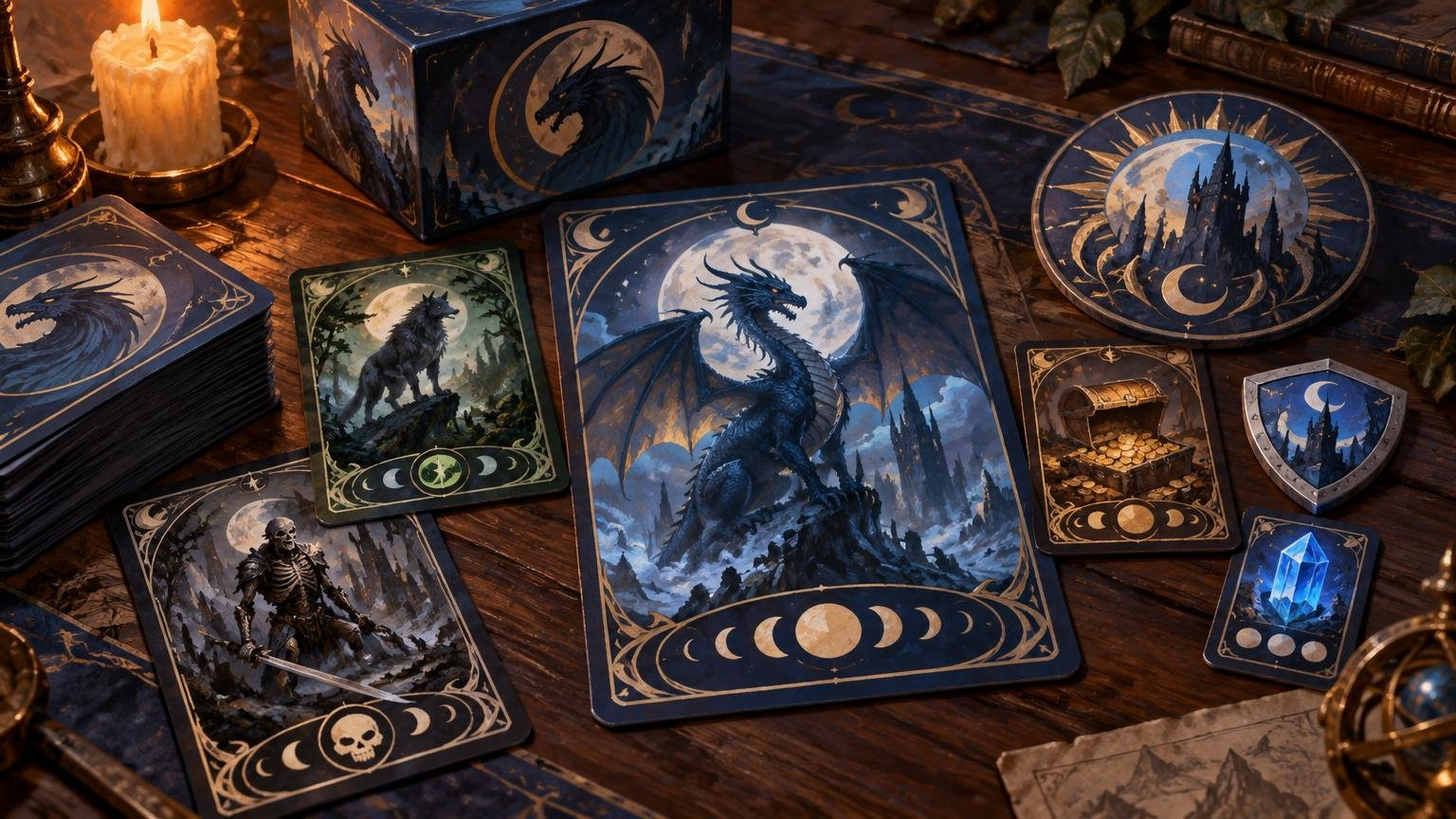
Matching tokens should look related without looking identical. Start with one or two shared visual elements: a border treatment, color palette, illustration style, faction symbol, texture, or title bar. A sea-monster deck might use deep blue-green frames and nautical ornament. A gothic Vampire deck might use desaturated portraits, red accents, and matching nameplates. A retro-artifact deck could use schematic backgrounds and restrained metallic colors.
Then create functional differences on top of that common foundation. The token name should have strong contrast. Power and toughness should occupy a consistent, obvious position. Flying, deathtouch, vigilance, and other abilities should be readable without picking the card up. If a token has no printed ability, do not fill the text box with decorative prose that looks like rules text.
The safest design hierarchy is simple:
- Token name and permanent type
- Power and toughness, if the token is a creature
- Rules text and relevant keywords
- Visual distinction from other token variants
- Theme, art, flavor text, and decorative details
That hierarchy may sound unfashionably practical, but Commander battlefields become crowded. The token’s job is not finished when it looks good in a gallery. It has to remain understandable next to a commander, three enchantments, a graveyard that has become a second hand, and the inevitable die balanced on something it should not be balanced on.
Do not let shared creature types hide mechanical differences
One Saproling card cannot automatically represent every Saproling your deck makes. One effect might create a plain 1/1 green Saproling, while another creates a token with a different size, color, ability, or additional type. The same problem appears frequently with Spirits, Zombies, Soldiers, Treasures, and token copies.
Create a distinct card whenever a difference matters to decisions at the table. At minimum, separate tokens when they have different:
- Power or toughness
- Colors or color combinations
- Card or creature types
- Printed abilities or keywords
- Names that matter to another effect
- Modification from the creating effect
- Copied characteristics
Art alone should not carry this distinction. Two illustrations may look clearly different while held side by side, yet become nearly indistinguishable across a four-player table. Change the nameplate, frame accent, icon, or power/toughness treatment as well. Cohesion comes from repeating a system, not from making every object wear the same costume.
Create the inventory from the locked deck list
Do the token audit after the main list is stable. Otherwise, every card swap can quietly add or remove another helper piece. The Commander proxy order checklist provides a wider pre-order audit covering tokens, double-faced cards, the commander, and other extras.
Search the locked list for cards that create, copy, transform, or modify game objects. Record the complete characteristics of every token named by those effects. Do not stop at creature token producers: inspect planeswalkers for emblems, cards that create artifact tokens, effects that make token copies, and cards that place unusual counters on permanents or players.
A practical inventory can include these columns:
- Source card
- Helper-piece category
- Token or emblem name
- Color and types
- Power and toughness
- Abilities
- Whether multiple variants exist
- Expected board volume
- Desired physical quantity
- Special tracking notes
Copy effects deserve their own flag. A generic Copy token card can be useful, but it needs a clear way to identify the copied object. For one copy, placing the reference beside the original may be enough in casual play. For several copies of different permanents, use labeled markers or writeable sleeves so everyone can tell which copy is which.
Choose quantities for readable board states
There is no universal correct number of each token. Carrying one of everything is compact but can become awkward when one token is attacking, another is tapped, and a third has summoning sickness or different counters. Carrying a separate card for every token a deck could theoretically generate turns the accessory pack into a small filing cabinet.
Choose quantities according to how the token behaves:
| Token pattern | Practical quantity approach |
|---|---|
| Occasional unique token | One may be sufficient if it rarely appears in multiples |
| Repeated creature production | Carry enough cards to separate important combat groups, then use dice for additional quantity |
| Different versions of one creature type | Carry at least one clearly labeled card for each mechanical version |
| Token-copy strategy | Use several copy markers with space for identifying the copied permanent |
| High-volume artifact tokens | Use a few dedicated cards plus dice, while separating tapped and untapped groups |
| Planeswalker emblem | Usually one dedicated emblem reference per relevant ultimate is enough unless the effect can be repeated |
Think in board states, not maximum output. Ask whether the deck routinely needs to show tapped and untapped Treasures separately, attackers and blockers separately, or tokens with different counters separately. A die communicates quantity well; it does not communicate every state. Two token cards with smaller numbers are often clearer than one card carrying the total population of a minor nation.
Give emblems and trackers their own design language
Emblems should not look like creature tokens. They occupy a different game zone and usually contain persistent ability text, so give them a conspicuous “Emblem” label, full readable text, and a frame that remains related to the deck without copying its creature-token layout. A planeswalker portrait or matching symbol can connect the emblem to its source.
Counters need a different treatment again. If +1/+1 counters, shield counters, charge counters, and loyalty counters may share the battlefield, use different colors, shapes, labels, or marker styles. A plain six-sided die works for quantities when its meaning is obvious; labeled markers help when multiple counter types could occupy the same permanent.
Reference aids should prioritize usability over spectacle. Put the tracked choice, sequence, or recurring trigger in large type. If the aid summarizes a card, check it against the current Oracle wording before relying on it. Keep these aids visually distinct from cards that can enter a library or hand so cleanup is painless.
Order and inspect the complete accessory package
Once the inventory is complete, reconcile it separately against the locked 100-card list. That approach matches the site’s established order workflow and reduces missed variations. If you are still converting a digital list into a physical build, the guide to a finished 100-card Commander deck covers the wider deck-to-table process.
Commander Proxies states that it offers complete decks, staples, land bundles, custom card builds, and token or add-on options depending on the build. Check the current product configuration before assuming a particular token package is included. If you instead want individually selected printed proxy cards, keep the helper-piece inventory separate so the deck cards and accessories are easy to reconcile.
When the pieces arrive, inspect them as game objects rather than merely as illustrations. CommanderProxies’ quality checklist highlights readable text, sleeve fit, shuffle feel, and consistent construction as practical arrival checks. For tokens and emblems, concentrate especially on contrast, accurate characteristics, trimmed text, and immediate differentiation between variants.
- Count the main deck and helper pieces separately.
- Match every token variation to its source card.
- Confirm that token names, types, colors, abilities, and power/toughness are correct.
- Read emblem text at normal table distance.
- Check that related tokens are cohesive but mechanically different versions remain obvious.
- Sleeve or organize extras so they cannot be shuffled into the deck.
- Bring dice or counters suited to the quantities and states the deck creates.
Custom tokens at casual tables and sanctioned events
For casual Commander, discuss unusual representations with the group and make every object clear. A custom illustration is rarely the problem; ambiguity is. Opponents should not need an art-history degree to determine which Spirit has flying.
Sanctioned-event policy draws an important distinction between player-created proxy deck cards and game aids. The supplied Magic Tournament Rules say player-created proxy deck cards are not permitted, apart from limited Head Judge-issued proxies in specified circumstances. The same document allows representations for game aids such as tokens and dungeons when they are clear to both players. Consult the current Magic Tournament Rules and the event’s judges before attending, rather than assuming a casual proxy policy applies to sanctioned play.
Finish the deck by making every object obvious
A strong themed token package repeats the deck’s visual language while reserving its clearest design choices for gameplay information. Inventory every generated object, separate mechanical variants, choose quantities around realistic board states, and give tokens, counters, emblems, and reference aids distinct jobs.
The next step is straightforward: lock the deck list, audit every token-producing and emblem-producing card, and build one master accessory inventory before choosing art. Theme should unify the package. Readability should decide it.