
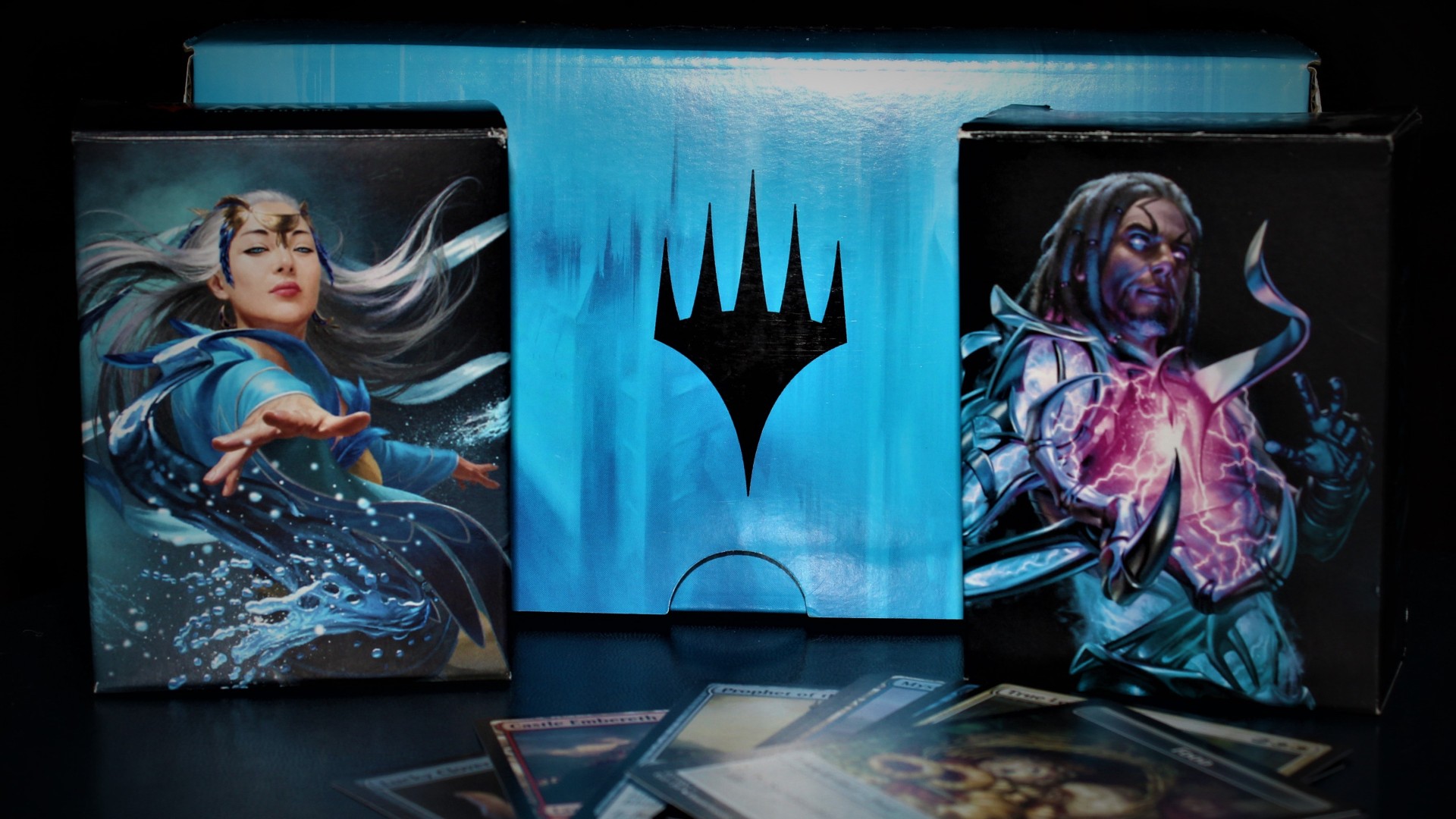
Deck building in Magic isn’t about finding “the perfect 60” or “the perfect 100.” It’s about building a deck that does its thing reliably, has enough mana to function, and can interact when something scary happens.
If you can nail those three ideas, you can build decks that feel good to play even before you know every card ever printed.
What a “good” MTG deck actually is
A solid beginner deck usually does three things:
- Has a plan
“I’m attacking fast.” “I’m controlling the game and winning late.” “I’m building a board of tokens.” Whatever—just make it one main plan, not four. - Finds its plan consistently
Consistency comes from the deck’s structure: land count, mana curve, and (in 60-card decks) playing multiples of your best cards. - Doesn’t fold to the first problem
You need interaction—removal, counterspells, board wipes, graveyard hate, etc.—so you’re not just watching someone else do the cool thing.
That’s the whole game in miniature.
Step 1: Pick your format (because deck rules change)
Different formats have different deck sizes and deck-building rules. You don’t need to memorize everything—you just need to pick what you’re building for.
60-card Constructed (the “classic” way to learn)
Most 1v1 Constructed formats use a minimum of 60 cards in the main deck, and many support an optional sideboard (often up to 15 cards).
This is the easiest place to learn consistency, because you can run up to 4 copies of key cards.
Commander (the most popular casual format)
Commander decks are exactly 100 cards total—99 + your commander—and (outside of basic lands) you generally play one copy of each card.
Commander is amazing, but the singleton rule makes “consistency” feel different—more redundancy and more card draw, less “4-of” precision.
If you’re brand new, build for the format your friends actually play. That’s the correct choice 99% of the time.
Step 2: Choose a simple deck plan (win condition + play style)
Here are beginner-friendly “deck jobs.” Pick one:
- Aggro: win fast with efficient creatures/burn.
- Midrange: solid threats + removal; win by being the best thing on turns 3–7.
- Control: stop threats, draw cards, win later with a finisher.
- Combo: assemble A + B (or A+B+C) and win in a burst.
Most beginner decks become better instantly when you say:
“I’m building Aggro,” and then stop adding random 7-drops “just in case.”
Step 3: Build around the 3 pillars (mana, curve, interaction)
Pillar A: Mana (lands + fixing + ramp)
You can’t cast spells you can’t pay for. A deck that “feels bad” is often just a deck that misses land drops or can’t produce the right colors.
Beginner land-count starting points
- 60-card decks: start at 24 lands.
- Go down to ~22 if your deck is very low curve (lots of 1–2 mana spells).
- Go up to ~26 if you’re control or you have lots of 4–6 mana spells.
- Commander: start at 37 lands.
- You can shave lands if you run lots of ramp and your curve is low.
- You’ll add lands if your deck is expensive and you keep stumbling early.
If you only remember one thing: add lands before you blame “bad luck.”
Pillar B: Mana curve (how your deck “spends” the early turns)
Your mana curve is the distribution of spell costs in your deck. A beginner trap is building a deck where half the spells cost 4+ and then wondering why nothing happens until turn 5.
A healthy beginner curve usually means:
- You have plays on turn 1–2
- Your deck does its main thing on turn 3–4
- Your “big finish” is the top end, not the whole deck
Quick check: shuffle up, draw 7, and ask:
- “Can I play something by turn 2?”
- “If I miss my third land drop, do I still have plays?”
If the answer is “no” a lot, lower your curve or add lands.
Pillar C: Interaction (don’t just goldfish)
Interaction is anything that stops the opponent’s plan: removal, counters, board wipes, protection, disruption.
Beginner rule of thumb:
- 60-card decks: aim for 6–12 interactive spells (depending on your archetype).
- Commander: aim for 8–12 pieces of interaction, plus 2–4 board wipes if your colors support them.
If your deck loses to “one big creature,” you need more interaction. If your deck loses because you never advance your own plan, you might have too much interaction and not enough threats.
Step 4: Use a deck skeleton (the easiest way to build fast)
Deck skeletons are “starter ratios” that you tune after playtesting.
A beginner 60-card creature deck skeleton
This is a great first build because it teaches curve + combat + removal.
- 24 lands
- 20–28 creatures (your main pressure)
- 6–10 removal/interaction
- 4–8 card advantage or utility (draw, protection, pump, etc.)
If you’re building a tribal deck (Goblins, Elves, Soldiers), that “creatures” number goes up and your spells get more synergistic.
A beginner 60-card control-ish skeleton
- 26 lands
- 10–16 win conditions (a small number of finishers is normal)
- 10–14 answers (removal/counters)
- 8–12 card draw / selection
Control wins by not dying, then winning eventually. If you stuff too many “cool finishers” in, you’ll die with them in hand.
A beginner Commander deck skeleton (simple and reliable)
Commander decks vary wildly, but this template builds functional decks fast:
- 37 lands
- 10 ramp (mana rocks, land ramp, etc.)
- 10 card draw (repeatable draw is premium)
- 10 interaction (spot removal + protection/counters)
- 3 board wipes (if your colors allow)
- 30–35 synergy/engine cards (the “theme”)
- 5–8 finishers / closers (how you actually end the game)
You can bend these numbers, but if you’re new and your deck feels clunky, coming back to this structure fixes a lot.
Step 5: Pick “redundancy” (how your deck stays consistent)
This is where 60-card decks and Commander feel different:
In 60-card decks
Consistency comes from playing multiples. Beginners often run too many 1-ofs “because I like them,” and the deck becomes a random pile.
A simple approach:
- Find your 8–12 best cards for your plan
- Play 3–4 copies of them (where legal)
- Fill the rest with support and interaction
In Commander
You can’t run 4 copies (usually), so you build consistency through:
- Redundancy (multiple cards that do similar jobs)
- Tutors/search (if your group uses them)
- Card draw (seeing more cards = finding what you need)
- Commander synergy (your commander is always available)
If your Commander deck “never finds the thing,” you usually need more draw and more redundancy, not more cute one-off tech.
Step 6: Build your mana base without overthinking it
Mana bases can get deep fast. For beginner deck building, keep it simple:
- Start with more basics than you think you need.
- If you’re 2 colors, add some dual lands/fixing, but don’t fill your deck with lands that always enter tapped.
- If you’re 3+ colors, you need more fixing (and you should expect your first builds to be a little slower).
Beginner tip: a lot of “my deck is bad” moments are actually “my mana is bad.”
Step 7: Playtest like a deck builder (not like a card collector)
You don’t need 100 games. You need intentional tests.
Do a quick “goldfish” test (solo test)
Draw 7 and play out your first 4 turns as if no one interacts.
- Do you hit land drops?
- Do you have plays each turn?
- Do you do your deck’s main thing by turn 4?
Do this 5 times. You’ll learn more than you expect.
Then play real games and track only 3 things
After each game, write down:
- Why did I lose (or win)?
- What card felt stuck in hand all game?
- What did I wish I drew?
That’s enough data to make smart changes.
Common beginner deck-building mistakes (and quick fixes)
“I never have enough lands.”
→ Add 1–2 lands (seriously). Or lower your curve.
“My hand is full of expensive cards.”
→ Cut 2–4 of your highest-cost spells and add cheaper plays.
“I lose to flyers / big creatures / graveyard stuff.”
→ Add targeted interaction that answers that specific thing.
“My deck has cool cards but no actual win.”
→ Add clearer finishers or a stronger engine that closes games.
“I keep drawing the wrong half of my deck.”
→ Increase redundancy (more similar effects), add card draw, simplify your theme.
“My Commander deck feels slow and I’m always behind.”
→ Add more ramp and more 2–3 mana plays. Commander is still Magic—you need early turns.
Beginner deck-building rules you can trust
If you want the “sticky notes on your monitor” version:
- Keep your deck’s plan one sentence long.
- Build your curve so you can play Magic before turn 4.
- Add interaction so you’re not a spectator.
- Don’t get fancy with mana bases until the deck works.
- When in doubt: lower the curve, add lands, add draw.
FAQs
Is it okay to play more than 60 cards?
You can, but you usually shouldn’t—extra cards reduce consistency. Most Constructed rules are “60 minimum,” not “60 exact,” but competitive decks almost always stick to the minimum for consistency.
How many lands should a beginner run?
Start at 24 lands in 60-card decks and 37 lands in Commander, then adjust after playtesting.
How do I know my deck has enough interaction?
If you frequently lose to a single threat you couldn’t answer, you need more. If you frequently lose because you didn’t advance your own plan, you might need fewer answers and more threats/engine pieces.
Should I build mono-color first?
If you’re brand new, yes—mono-color decks teach fundamentals (curve, combat, sequencing) without mana fixing headaches.
What’s the fastest way to improve a deck?
Cut your clunkiest cards, lower your curve, and tune based on 5–10 games of notes. Small changes compound quickly.