

This post helps Commander players choose the right Commander for their deck by using a simple decision framework, so they can build something they actually want to shuffle up (and not “take apart after two games”).
TLDR
- Start with your table’s vibe (power, speed, salt tolerance). Your Commander should match the room.
- Pick a play pattern first (combat, value, spells, graveyard, tokens, combo, control), then pick colors that support it.
- Run the Commander Fit Test: castable, provides advantage, has a clear job, and won’t make your deck fold to one removal spell.
- Shortlist 3 commanders, proxy them, play 2–3 games each, then commit. Your wallet will survive this process.
You can choose the right Commander for your deck in about 15 minutes. You can also spend three weeks reading legendary creatures like it’s a personality quiz. Both are valid coping mechanisms.
The trick is this: your Commander is not “the cool card.” Your Commander is the steering wheel. If you pick the wrong one, the rest of the deck becomes you frantically pedaling a tricycle downhill.
Step 0: Pick the table first (yes, before the Commander)
Commander is a social format wearing a card game costume. So before you pick a legend, you want a basic read on your environment:
- Speed: Are games ending around turn 7–9, or are you all writing a novel together until turn 14?
- Interaction: Is removal normal, or do people act personally betrayed by a single counterspell?
- Combo tolerance: Are two-card “oops I win” lines common, rare, or actively punished by eye contact?
- Theme vs power: Does the pod reward flavor, or does it reward efficiency?
A quick Rule 0 script you can actually say out loud
“What kind of game are we aiming for tonight? Are fast combos and heavy tutors cool, or are we keeping it battlecruiser and vibes?”
If you do this, you will prevent at least one miserable game. That is a better win rate than most precons.
How to choose the right Commander for your deck
Here’s the core framework: Choose your play pattern, then your colors, then your Commander.
Not the other way around.
1) Choose a play pattern (what you do every game)
A Commander deck is 100 cards, but you are going to repeat the same 6–10 actions a lot. So pick what you want those actions to be.
Use these prompts:
- Do you want to attack or assemble?
- Do you enjoy big turns (one explosive turn) or steady engines (incremental value)?
- Do you like lots of decisions each turn, or do you want the deck to play itself while you sip something judgemental?
Common play patterns people actually stick with:
- Combat / Aggro / Stompy: You win by turning creatures sideways and making that a real plan.
- Tokens / Go-wide: You generate an army, then turn one anthem into a crime scene.
- Voltron: One creature, one problem, 21 damage, many regrets.
- Spellslinger: Lots of instants/sorceries, “I swear I’m almost done resolving this stack.”
- Graveyard / Reanimator: Your graveyard is a second hand, and occasionally a third hand.
- Aristocrats: Creatures enter, creatures die, everyone loses life, and you look innocent.
- Artifacts / Enchantments: Engine-based decks where your permanents do the heavy lifting.
If you cannot describe how you win in one sentence, you probably picked “value” as a strategy. Value is not a strategy. Value is what happens when you refuse to commit.
2) Choose colors that support that plan (color identity matters)
Your Commander’s color identity determines what you can play in the 99. It is based on mana symbols in the card’s mana cost and rules text, plus color indicators and certain defining abilities. That’s why a commander can be “one color” on the mana cost, but still lock you into more colors because of symbols in the text box.
This is the part where people get surprised by hybrid mana, off-color activations, or a back face that quietly adds a color. Commander does not care if you “promise you won’t activate it.” The deck rule still cares.
If you’re new (or just tired), here’s the practical version: when in doubt, check the Commander’s full oracle text and any back face, then treat every mana symbol as binding.
3) Pick the Commander role, not just the Commander
Most Commanders fall into one of these roles. Knowing which one you’re choosing prevents a lot of bad deckbuilding:
- Engine Commander: Draws cards, makes mana, creates resources repeatedly. Builds consistency.
- Payoff Commander: Rewards you for doing the thing (counters, tokens, spells, artifacts).
- Enabler Commander: Makes the thing possible (cost reduction, extra triggers, rule-bending).
- Toolbox Commander: Flexible options, answers, or repeated access to utility.
- Finisher Commander: Helps close games, often by making combat lethal or doubling output.
Engine Commanders feel “strong” because they solve Commander’s two biggest problems: mana and cards.
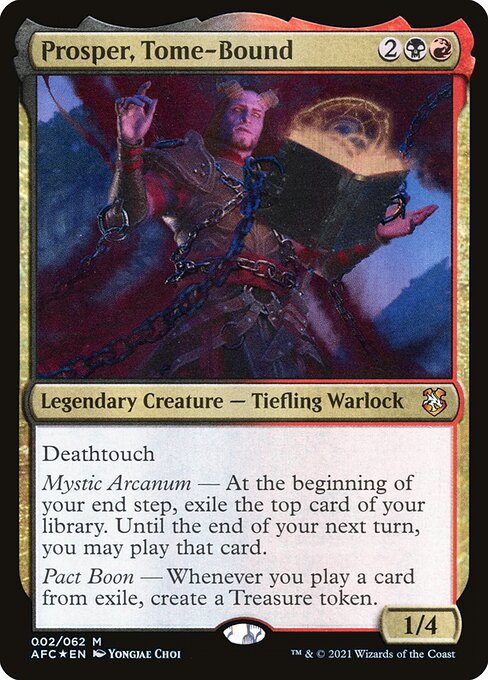



Mystic Arcanum — At the beginning of your end step, exile the top card of your library. Until the end of your next turn, you may play that card.
Pact Boon — Whenever you play a card from exile, create a Treasure token.
The Commander Fit Test (a quick scorecard)
Before you commit, run your candidate through this. If it fails two or more checks, you are signing up for extra deck edits later.
Check 1: Can you cast it on time, repeatedly?
- What is the mana value?
- How many colored pips?
- Does your deck realistically cast it on curve and recast it later?
A Commander that costs 6+ can be great. It just means your deck needs more ramp, more lands, and more protection. If you are not willing to do that, choose a cheaper Commander. This is not moral advice. It’s math.
Check 2: Does it help you recover?
In Commander, your plan will get disrupted. So your Commander should either:
- provide card advantage (draw, impulse draw, recursion), or
- provide mana acceleration, or
- provide inevitability (you keep progressing even through removal)
If your Commander does none of those, your deck needs to do all the heavy lifting. That’s fine, but it’s harder, and your opening hands will feel swingier.
Check 3: Is the deck functional when the Commander is gone?
Ask yourself: if your Commander is removed twice, do you still have a game?
If the answer is “no,” you need:
- redundancy in the 99 (more effects that do the same job), and
- protection/recursion, and
- a secondary win line
A build-around Commander is totally okay. A build-around Commander with no backup plan is just volunteering to have a bad time.
Check 4: Is the job of the deck clear?
You want one clear sentence:
- “This deck makes tokens and buffs them.”
- “This deck plays from the graveyard and grinds value.”
- “This deck casts lots of spells and wins with a big turn.”
If your sentence has four “and”s in it, you built a Commander deck and a wishlist at the same time.
Check 5: Does it match your tolerance for complexity?
Be honest:
- Do you want to track 12 triggers and 3 replacement effects every turn?
- Or do you want clean turns with decisive combat steps?
There’s no prize for “most complicated board state.” The prize is finishing a game before someone has to leave.
Check 6: Will your table enjoy playing against it?
Not “will they lose to it,” but “will they enjoy the game.”
Some commanders create repetitive games, long turns, or lockouts. If your group loves that, great. If not, pick something that produces interaction instead of misery.
If you’re unsure, say this in Rule 0:
“This deck can do some swingy stuff. Are you all cool with that?”
Check 7: Does your budget match your ambition?
Commander is the format where your mana base can cost more than your car’s first repair.
If you use proxies for casual play, you can test commanders without turning deckbuilding into a financial decision. It also lets you find out if you even like the play pattern before you chase staples.
The tradeoff is time: you still need to iterate, tune, and actually play games. There is no shortcut that does not involve shuffling.
A simple shortlist method that works
Instead of hunting for “the perfect commander,” pick three candidates:
- One that is clearly powerful and consistent (often an engine)
- One that is pure theme and makes you smile
- One weird option that might be secretly great
Then play two games with each. Track:
- Did you have fun piloting it?
- Did the deck do its thing without perfect draws?
- Did your turns feel fair-paced, or like you were apologizing every upkeep?
After that, choosing is easy. Your body will know. Your group will also know, because they will stop making that face at you.
Common Commander-picking traps
“Five colors so I can play everything”
Five-color is a real identity, but “everything” is not a game plan. If you are going five-color, have a reason beyond “I want the best cards.”
“My commander is a payoff, but my deck has no engine”
If your commander rewards you for doing something, your deck still needs a way to do the thing consistently. Payoffs do not replace infrastructure.
“My commander costs seven, but I built like it costs three”
This is the classic. It’s also fixable: add ramp, add lands, add protection, cut cute cards that do nothing until turn nine.
“I chose a commander because it looks cool, and now I hate the deck”
This happens. Art is persuasive. Legendary creatures are basically little cardboard influencers.
If you love the card but hate the play pattern, keep the card for the binder and choose a commander that matches how you like to play. This is personal growth, the kind that hurts a little.
Quick example: matching commander to play pattern
If you love combat and clean turns, look for commanders with:
- built-in evasion (flying, trample)
- combat scaling (tokens, buffs, extra combat pressure)
- a clear “end the game” lever
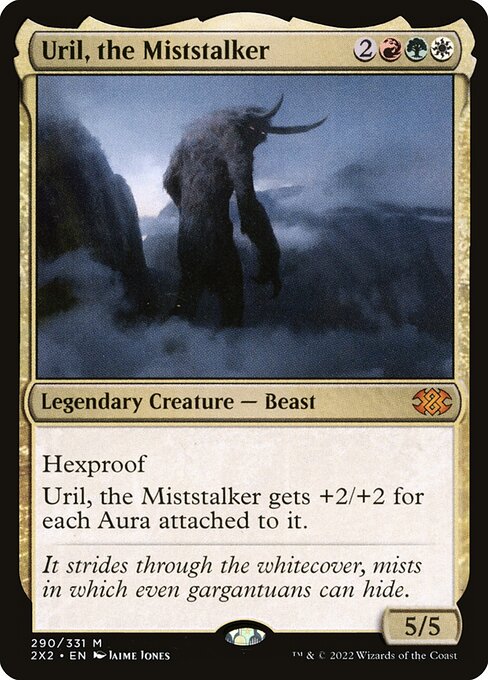


Uril gets +2/+2 for each Aura attached to it.
If you love engines and resource snowballs, look for commanders that:
- draw or pseudo-draw
- make mana or mana-like resources
- turn your normal actions into extra material (treasures, clues, recursion)
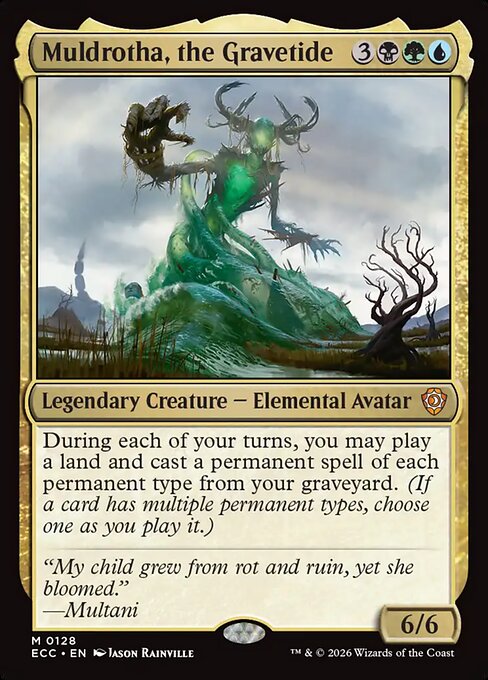


—Multani
(These are examples, not commandments. The Commander gods are busy and mostly unhelpful.)
FAQs
What’s the best commander for beginners?
One that is cheap to cast, has a clear theme, and creates card advantage so you are not topdecking into sadness. Precon face commanders are often good at this.
Should I choose a commander based on colors or ability?
If you have a play pattern you love, start with ability. If you have colors you love, start with colors. Either way, make sure the Commander’s ability supports a real plan, not just “seems neat.”
How do I know if my commander is too strong for my playgroup?
If your deck regularly runs away with the game, takes very long turns, or shuts off other players’ ability to participate, it might be mismatched. Ask your group. If they hesitate before answering, that is also an answer.
Is it okay if my deck doesn’t rely on the commander?
Yes. Some decks treat the commander like a bonus tool rather than the whole plan. Just make sure your 99 has enough cohesion and access to card advantage.
How many commanders should I test before committing?
Three is the sweet spot. One is too few, ten is a lifestyle choice.